

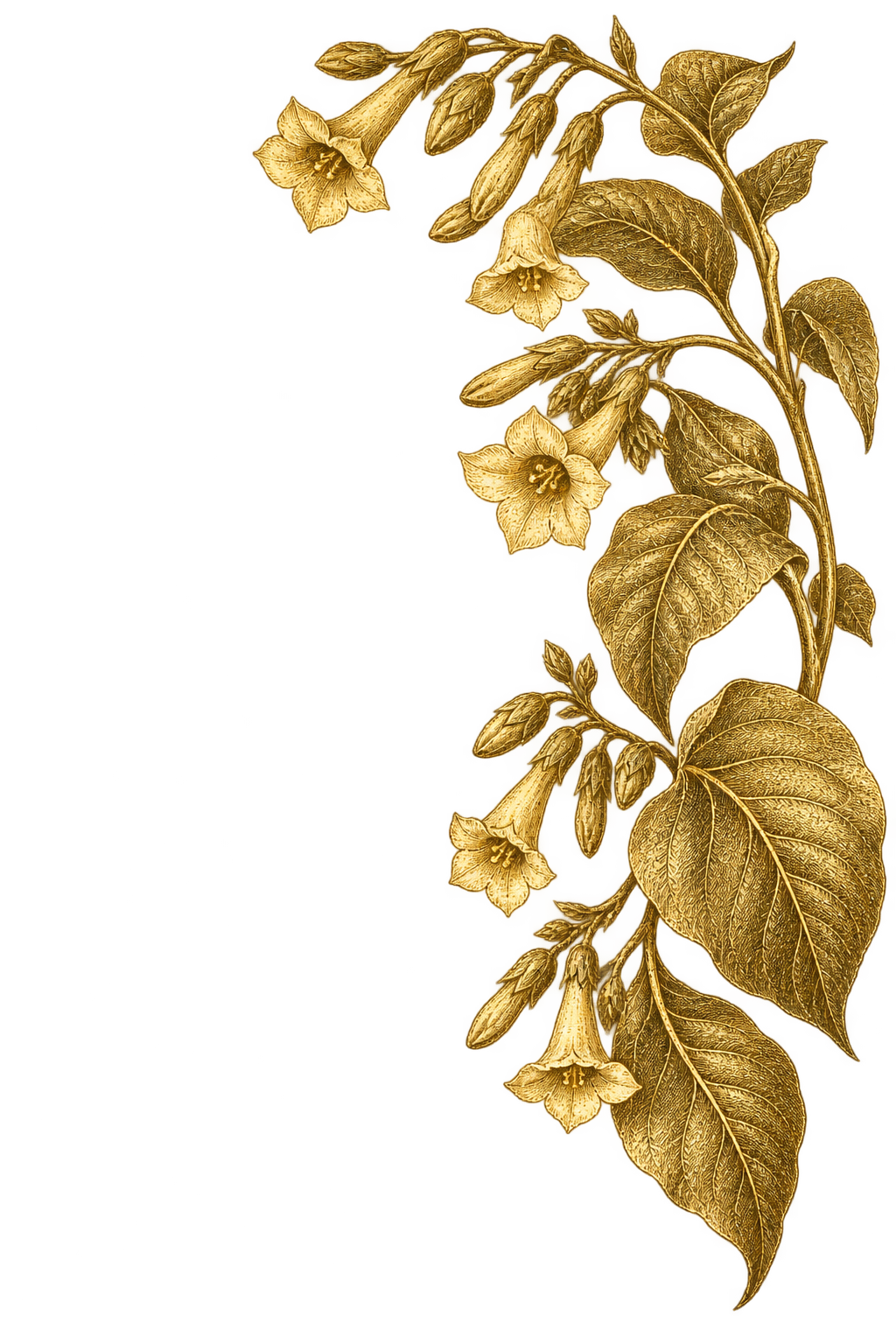
Oil of Tobacco
Sometimes the answer sits in front of you for years before it taps you on the shoulder.
I'd been distilling tobacco, misting tobacco, writing about tobacco. Then one morning I woke up and it landed all at once: castor oil and tobacco. That's what needs to happen. Not a patch, not a pouch, not one more synthetic shortcut. The whole leaf, steeped slow in oil, married to castor and OrmusGold. That epiphany became the Oil of Tobacco.
This is the deeper story: the plant, the receptors it speaks to, why the isolate falls short, and how the oil and the hydrosol each have their place.
✦
The Plant Before the Product
Long before tobacco was rolled into cigarettes, it was medicine and ceremony. Indigenous peoples across the Americas honored it as a sacred plant, a protector, a messenger. They used it in prayer, laid it on the body as a poultice, and offered it as a gift.
The tobacco in this oil is Nicotiana rustica, known in South America as mapacho. It's the elder of the tobaccos and the strongest of them. Rustica leaves can carry up to about 9% nicotine, while common tobacco, Nicotiana tabacum, carries roughly 1 to 3%. Mapacho is the tobacco of the curanderos, used ritually for its grounding and focusing effects.
Ours comes from a small family farm in the Appalachian mountains, grown with care and harvested by hand.
✦
The Receptors: A Lock Your Body Already Owns
Here's something most people never hear: your body has its own nicotine receptors, and it had them long before anyone lit a cigarette.
They're called nicotinic acetylcholine receptors. Your body's own messenger, acetylcholine, is the natural key that fits them. Nicotine happens to fit the same lock, which is how the receptors got their name. They're found throughout the nervous system, in the brain, at the junction where nerves meet muscle, and on many cells of the immune system.
One of these receptors, called alpha-7, has become a major focus of research. It's a key part of what scientists call the cholinergic anti-inflammatory pathway. The vagus nerve releases acetylcholine, and when that signal reaches alpha-7 receptors on immune cells, the cells turn down their production of inflammatory signals. It's one of the ways the nervous system and the immune system talk to each other. In the lab, nicotine mimics acetylcholine at this receptor.
I find that beautiful. The body was built with a place for this plant's language. That doesn't make tobacco a cure for anything, and I won't tell you it is. But it does tell me why this plant has been honored for thousands of years, and why it deserves more respect than the cigarette ever gave it.
✦
Why the Isolate Falls Short
The modern world took this sacred plant and did two things to it. It burned it, and it isolated it.
The nicotine patch, the gum, the pouch and the vape all deliver nicotine as a single compound, often made synthetically. The patch in particular is engineered to feed a steady stream into the bloodstream for 16 to 24 hours at a time.
The most common side effects people report from the patch:
- Skin irritation where it sits: redness, itching, burning or rash
- Trouble sleeping and vivid dreams, especially with patches worn overnight
- Headaches and dizziness
- Nausea and upset stomach
- A racing heart, most often when the dose is too high
Notice how many of these come from the same thing: a constant drip of one compound, day and night, whether the body asked for it or not. The usual advice for the sleep problems is simply to take the patch off at night. In other words, give the body a break from the stream.
The body doesn't live in a constant stream. It lives in rhythm.
✦
Why the Whole Plant
A tobacco leaf isn't just nicotine. Nicotine is the main alkaloid, but the leaf carries a whole family of related alkaloids alongside it, including nornicotine, anatabine, anabasine and myosmine, plus the plant's other natural compounds. Most of those alkaloids speak to the same receptors in their own way, each a little differently than nicotine does.
That's the difference between an isolate and a plant. An isolate is one voice. A plant is a choir. Plant medicine has always worked this way, with the whole leaf, the way it grew, the way generations of healers used it.
And the way you use it matters just as much as what it is. Oil of Tobacco isn't a patch you wear around the clock. You apply it where you need it, when you need it, and then you let the body rest. That's rhythm, not a drip.
✦
The Epiphany: Tobacco, Castor & OrmusGold
I've seen tobacco blended with all sorts of things. None of them felt right to me. When the idea of castor came, I knew it in my bones.
Castor oil is the classic oil of the castor pack, a body-tending ritual passed down through generations of folk healers. It's thick and rich, and it's naturally high in ricinoleic acid, a fatty acid found almost nowhere else in nature. It stays on the skin, holds warmth, and gives the tobacco somewhere to rest.
The wild tobacco is steeped slowly in organic MCT oil, a light, clear oil that carries the leaf's richness and sinks into the skin with ease. Then the infusion is married to castor and to OrmusGold, my signature alchemical ingredient, which brings the plant and the oils together as one.
The three together are the synergy: the strength of the leaf, the staying power of castor, and the light of OrmusGold.
✦
Oil or Hydrosol? Both Have Their Place
People love the Tobacco Gold Hydrosoul, and so do I. It's the mist of the garden, distilled by hand. But the hydrosol is small-batch and comes and goes with Mother Nature's timing. The oil is a different tool, and for many of you it may be the one you've been waiting for.
| Tobacco Gold Hydrosoul | Oil of Tobacco | |
|---|---|---|
| The plant | Nicotiana tabacum, from my garden | Nicotiana rustica (mapacho), the strongest tobacco |
| How it's made | Steam distilled with OrmusGold | Whole leaf steeped slow in MCT oil, blended with castor & OrmusGold |
| What it is | A light floral water | A rich, deep botanical oil |
| On the skin | Mists on and evaporates | Stays on the skin and holds |
| Strength | Gentle, everyday | Potent: a little goes a long way |
| Best for | Misting, daily ritual, all-over | Where needed, and castor oil packs |
| Availability | Small batches, sells out | Ready when you need it |
Think of the hydrosol as the morning mist, and the oil as the deep root.
And you don't have to choose. Keep both on your shelf and let your body tell you what it needs in the moment: the mist when you want something light and quick, the oil when you want to go deep.
✦
A Word on Potency
This oil is strong, and I want you to know that going in. There are three reasons:
- The plant. Rustica carries several times more nicotine than the tobacco in the hydrosol.
- The oil. A hydrosol is mostly water, and only part of the plant comes over with the steam. When the whole leaf is steeped in oil, the oil draws out the alkaloids and holds them.
- The contact. A mist evaporates. An oil stays put, and under a castor pack it stays in contact with the skin for a good while.
Whole plant doesn't mean weak. Tobacco farmers who handle wet green leaves all day can actually get sick from what absorbs through their skin. The leaf is that potent. So treat this oil with the respect you'd give any strong plant medicine. Start with a small area and a few drops, and see how your body responds.
✦
How to Use It
- Where needed: warm a few drops between your palms and massage into a small area, such as the belly, a knee, a shoulder or the low back.
- As a castor oil pack: smooth a thin layer over the area, cover with a soft flannel, and rest for 20 to 30 minutes.
- Wash your hands when you're done.
Mindful use: For external use only. Not for children or pets, or during pregnancy or nursing. If you have a heart condition or high blood pressure, or you're sensitive to nicotine, talk with your practitioner first. Keep out of reach of children.
✦
The Invitation
Tobacco has been misunderstood for a long time. Burned, isolated, sold back to us as a habit or a patch. The Oil of Tobacco is my way of returning it to what it was: a whole plant, honored, used with intention and rhythm.
If you've been following the work of Dr. Bryan Ardis and others exploring tobacco and the body's nicotinic receptors, I invite you to explore that research and decide for yourself. Everyone lives in their own cosmology.
Sources: Nicotiana rustica · GoodRx: nicotine patch side effects · Mizrachi et al., the α7 nicotinic receptor (2021) · Hone & McIntosh, nicotinic receptors & inflammation (2023) · Hall et al., minor tobacco alkaloids (2014)